

By Barnard Crespi
The conversation around agentic commerce is quickly moving beyond experimentation and into questions of operational readiness. While much of the public discussion still focuses on AI features and conversational interfaces, a more fundamental shift is beginning to emerge underneath the surface: the transition from human-led commerce to AI-assisted commerce, and eventually to completely autonomous agentic commerce.
That progression represents three distinct operational states, each with very different implications for organizations and businesses.
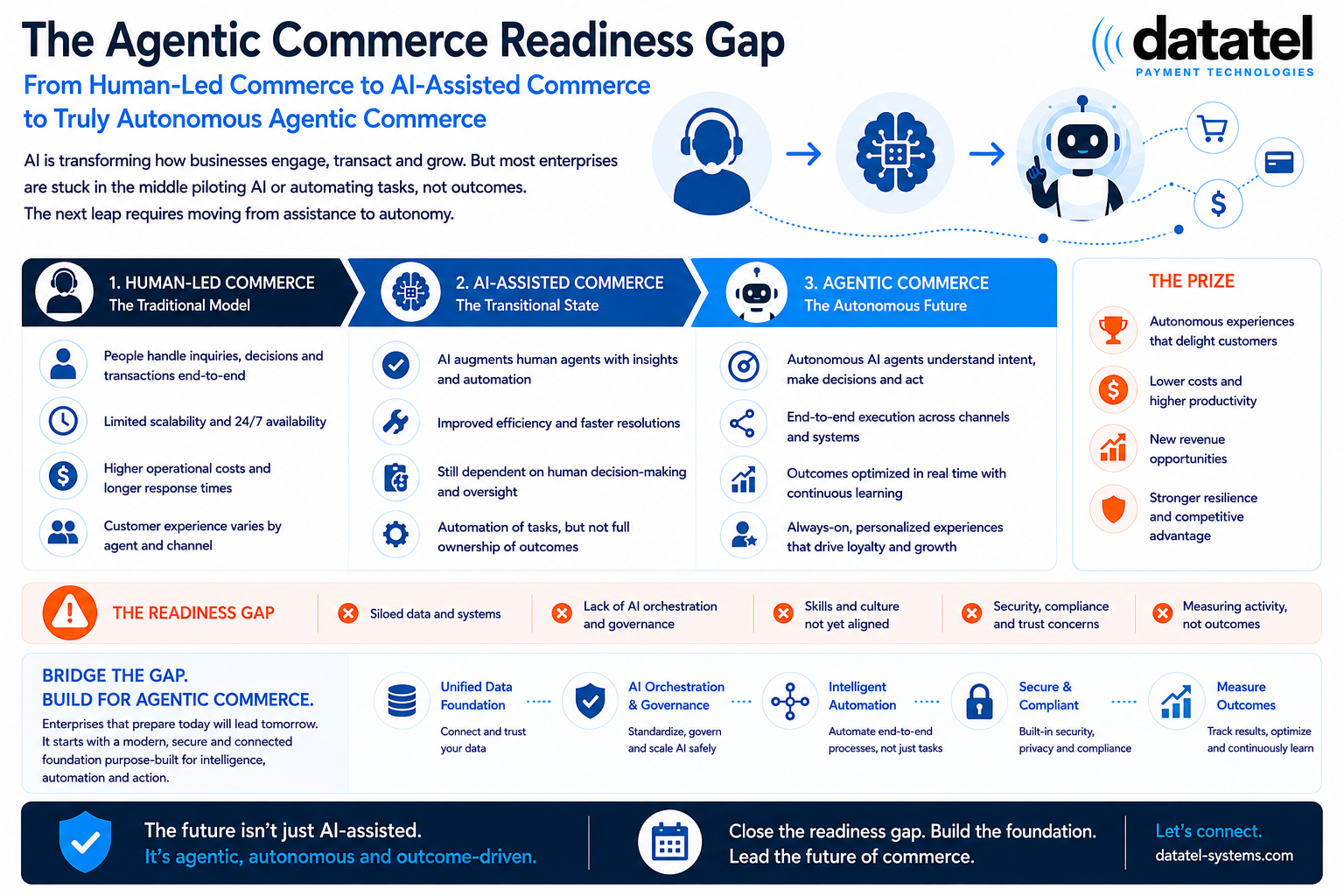
The current state of commerce is still largely built around human navigation and human decision-making. Customers search, compare, evaluate, approve, and purchase. Digital channels may support the process, but people remain at the center of discovery and execution. Most business systems, workflows, marketing strategies, and payment infrastructures are designed around that assumption.
AI-assisted commerce represents the next phase already beginning to take shape across industries. In this model, artificial intelligence helps accelerate or simplify decision-making, but humans still maintain direct oversight and final approval. Recommendation engines, AI copilots, conversational assistants, and intelligent automation tools all fall into this category. The customer journey remains human-led, but increasingly machine-supported.
Autonomous agentic commerce is different.
In that environment, AI agents do not simply assist users, they act on their behalf. Discovery, evaluation, negotiation, authorization, and purchasing become increasingly machine-driven processes executed according to predefined intent, trust rules, and contextual objectives.
That distinction matters because many organizations are preparing for the second state while underestimating the operational implications of the third.
Most organizations today remain optimized for human-led discovery, human approvals, and human exception handling. Websites are designed for visual interaction. Loyalty strategies assume direct customer engagement. Checkout flows are structured around manual input and explicit human confirmation. Even digital transformation initiatives often assume that people remain the primary navigators of commercial systems.
But autonomous agents change the structure of the interaction itself.
As AI systems begin acting on behalf of consumers and businesses, the competitive landscape may shift away from interface optimization alone and toward machine-readable infrastructure, structured product intelligence, payment orchestration, trust frameworks, and verifiable intent systems, all of which introduce new challenges in terms of readiness.
Organizations may soon need to think not only about how humans discover products and services, but also about how algorithms evaluate, prioritize, and execute decisions. Product data structures, API accessibility, payment authorization models, compliance frameworks, and decision transparency could become increasingly important operational capabilities.
The implications extend beyond technology teams.
Finance leaders may need to rethink authorization and payment approval processes in environments where transactions occur with reduced human interaction. Risk and compliance teams may face new questions around accountability, consent, and transaction validation. Marketing organizations may need to adapt to a world where brand influence competes alongside algorithmic selection logic. Operations teams may need to design systems capable of handling machine-to-machine interactions at scale.
The challenge is not simply adopting AI but also understanding where an organization currently operates across these three states, and determining what capabilities are required to move forward responsibly.
That readiness gap may become one of the defining business issues of the next phase of digital commerce.
Typically, organizations still approach AI through isolated pilots, chatbot deployments, or productivity experiments. While those initiatives may provide short-term value, they do not necessarily prepare businesses for environments where autonomous agents influence discovery, decision-making, and transaction execution across the commercial lifecycle.
The organizations that adapt successfully may not be the ones with the most visible AI features. They may be the ones that build the strongest operational foundations underneath them.
That includes structured decision infrastructure, trusted payment environments, interoperable systems, governance models, and frameworks capable of supporting machine-driven interactions without losing transparency or control.
The broader shift underway is not simply about automation. It is about the changing architecture of commerce itself.
The most important question facing organizations today may no longer be whether AI will participate in commerce. Rather, it is whether the business is operationally prepared for the transition from human-led commerce to AI-assisted commerce, and eventually to autonomous agentic commerce.
We’re Here to Help.
Call 1 800 831 6660 or
What our clients are saying about us
“The customer service on this team is remarkable – just excellent – always so supportive, responsive, patient, and solution driven.”
“Never any issues with you guys! Things just work.”
“Customer service is a really big deal to us, and I am glad to do business with a company that obviously takes it as seriously as we do.”
“We’re happy with the IVR Payment system and it has been working well for us. Recently we also setup your newest SMS (text) receipts and found it to work great.”
“I want to command you and your team at Datatel on the job just completed for Tele-Response Center. The attention to detail and professionalism with which you approached the project was exemplary and greatly appreciated especially considering the several applications that needed to be implemented on short notice. Thanks again for your assistance getting this project off the ground so smoothly.”
“My team and I would like to commend Datatel on creating an IVR application that adds great value to our new Travel product. Your knowledge, input and expertise in IVR scripting, call flow management and overall IVR logistics made the development and implementation stages extremely easy to manage. Thank you for a well executed campaign that was launched on time and on budget.”
“Great team to work with. I look forward to utilizing some additional capabilities in the future.”
“We are very grateful for many years of mutually beneficial business relationship with Datatel and for impeccable customer service we have received during these years.”
“We, Standard Life, very much appreciated Datatel’s expertise, knowledge and support as we worked through the development and implementation stages. Our Clients appreciate the simplicity of the capability, while gathering very valuable feedback. Thanks for making this a very positive experience.”
“This was one of the best implementations I have been a part of. The communication was excellent and everything was responded to and dealt with swiftly. A real pleasure. We are looking forward to the impact this will have on our patient payments! Thank you!”
