

By Barnard Crespi | May 25, 2026
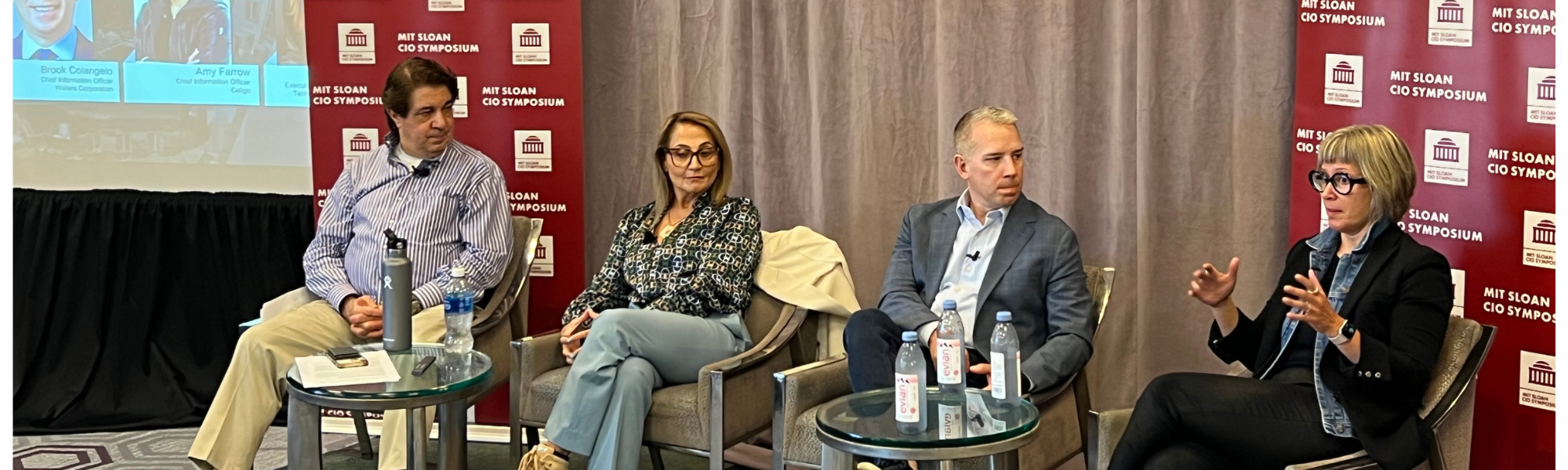
At this year’s MIT Sloan CIO Symposium 2026, one of the most practical and candid conversations focused not on AI hype, but on what it actually takes to operationalize AI at enterprise scale and connect it to measurable business outcomes.
Moderated by Mike Grandinetti , the session brought together senior technology leaders from Waters Corporation , Celigo, and Travelers to discuss the realities of deploying AI inside complex organizations.
Mojgan Lefebvre, Executive Vice President and Chief Technology & Operations Officer, Travelers
Brook Colangelo, Chief Information Officer, Waters Corporation
Amy Farrow, Chief Information Officer, Celigo
The discussion moved beyond experimentation and into the operational, financial, governance, and organizational challenges that CIOs are now facing as AI adoption accelerates.
Key Themes from the Session
AI Must Be Tied to Business Outcomes
A recurring theme throughout the panel was that AI initiatives cannot exist as isolated technology experiments. Successful organizations are tying AI investments directly to measurable operational outcomes, cost reduction, productivity improvements, customer experience, and revenue impact.
Examples discussed included:
- Redesigning enterprise operating models instead of simply automating existing workflows
- Replacing manual service functions with AI-enabled agentic processes
- Using AI to reduce operational friction in customer service and claims management
- Reimagining how human expertise and machine intelligence work together
The panel emphasized that deployment is not the finish line. Value realization is.
AI Transformation Is Organizational, Not Just Technical
One of the strongest insights from the discussion was the recognition that AI transformation is fundamentally a company transformation initiative, not simply an IT project.
The panelists repeatedly highlighted:
- The importance of executive sponsorship
- The need for cross-functional product teams
- Cultural readiness and change management
- Training tailored to specific roles and workflows
- The requirement for a “growth mindset” across leadership
Several speakers stressed that organizations treating AI purely as a technology rollout risk missing the larger opportunity and may struggle to generate enterprise value.
Agentic AI Requires Discipline and Governance
The conversation also explored the growing interest around agentic AI and autonomous systems.
The panel cautioned against assuming that agentic AI is the answer to every problem. Instead, the speakers framed agentic AI as a design choice that should only be used where:
- Processes are highly complex
- Multi-step orchestration is required
- Human-driven execution introduces too much cost or delay
- Governance and escalation paths can be properly managed
The panelists also noted that poorly governed agents can create operational risk, unexpected AI consumption costs, and significant oversight challenges.
Data Architecture and Observability Are Critical
Another important theme was enterprise readiness.
Before organizations can operationalize AI at scale, several foundational elements must exist:
- Strong data governance
- Clear access controls
- Auditability
- Reversibility
- Identity and action traceability
- Real-time monitoring and observability
One particularly practical insight was the idea of “working backward from failure.” The question organizations should ask is:
“If something goes wrong, how would we determine why it happened?”
That framing becomes a powerful pressure test for enterprise AI architecture and governance design.
The Economics of AI Are Becoming a Major Executive Issue
The panel also addressed an increasingly important topic: AI economics.
As organizations move from experimentation into production-scale AI systems, token consumption, autonomous agent activity, and model usage costs are becoming real operational and financial concerns.
The speakers emphasized:
- Hard consumption controls
- Monitoring and observability
- Cost accountability
- Chargeback methodologies
- Governance frameworks tied to business value
The message was clear: operationalizing AI without understanding the economics behind it creates significant enterprise risk.
Takeaway
Perhaps the most important insight from the session was this:
AI operationalization is no longer about proving the technology works. It is now about whether organizations can redesign workflows, governance models, culture, economics, and decision-making processes fast enough to create sustainable enterprise value.
The organizations that succeed will likely be those that move beyond experimentation and begin treating AI as an integrated business transformation capability, not simply another technology initiative.
Panel Summary Based on Session Notes and Discussion Transcript.
We’re Here to Help.
Call 1 800 831 6660 or
What our clients are saying about us
“The customer service on this team is remarkable – just excellent – always so supportive, responsive, patient, and solution driven.”
“Never any issues with you guys! Things just work.”
“Customer service is a really big deal to us, and I am glad to do business with a company that obviously takes it as seriously as we do.”
“We’re happy with the IVR Payment system and it has been working well for us. Recently we also setup your newest SMS (text) receipts and found it to work great.”
“I want to command you and your team at Datatel on the job just completed for Tele-Response Center. The attention to detail and professionalism with which you approached the project was exemplary and greatly appreciated especially considering the several applications that needed to be implemented on short notice. Thanks again for your assistance getting this project off the ground so smoothly.”
“My team and I would like to commend Datatel on creating an IVR application that adds great value to our new Travel product. Your knowledge, input and expertise in IVR scripting, call flow management and overall IVR logistics made the development and implementation stages extremely easy to manage. Thank you for a well executed campaign that was launched on time and on budget.”
“Great team to work with. I look forward to utilizing some additional capabilities in the future.”
“We are very grateful for many years of mutually beneficial business relationship with Datatel and for impeccable customer service we have received during these years.”
“We, Standard Life, very much appreciated Datatel’s expertise, knowledge and support as we worked through the development and implementation stages. Our Clients appreciate the simplicity of the capability, while gathering very valuable feedback. Thanks for making this a very positive experience.”
“This was one of the best implementations I have been a part of. The communication was excellent and everything was responded to and dealt with swiftly. A real pleasure. We are looking forward to the impact this will have on our patient payments! Thank you!”
