

By Barnard Crespi
Organizations that are looking to modernize their phone payments didn’t just suddenly became interested in payment technology, rather they are pursuing operational outcomes that include:
- Improved customer experience
- Accelerated collections
- Reduced operational friction
- Improved business continuity
- Lower dependency on manual processes
- Increased workforce efficiency
- Reduced PCI compliance pressure
- More scalable service operations
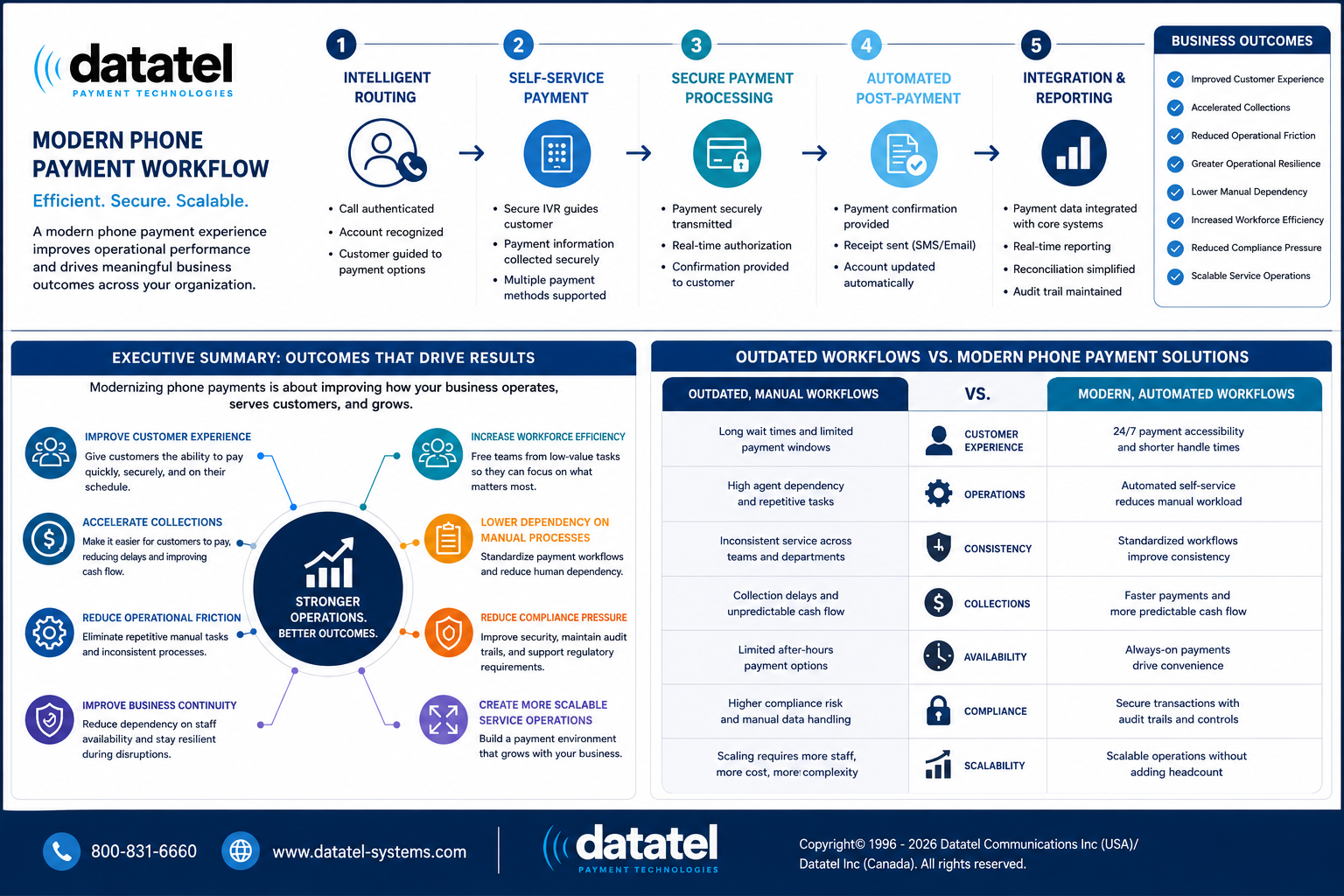
Operational Efficiency Begins With How Money Moves
Executives typically focus operational improvement efforts on customer service, digital transformation, automation, or workforce optimization initiatives.
Yet one of the most operationally influential workflows inside many organizations remains largely untouched: how payments move through the business. When payment interactions rely heavily on staff, organizations inherit operational constraints that impact multiple parts of the business simultaneously. This matters because payment workflows affect far more than just transaction processing.
For example:
- Customer service teams spend time facilitating repetitive payment interactions instead of resolving higher-value customer issues
- Peak billing cycles create pressure on staffing resources
- After-hours payment accessibility becomes limited
- Collections workflows become slower and more labor-intensive
- Operational inconsistencies emerge across teams and departments
- Supervisors spend more time managing exceptions and escalations
- Revenue collection becomes increasingly dependent on workforce availability
Over time, businesses compensate by adding more people, more procedures, and more operational oversight, resulting in even more complexity at the expense of scalability.
This is why many operational leaders are beginning to reassess phone payment environments altogether.
Not because payments are failing, but because the workflows surrounding them are limiting operational performance.
Customer Experience Is Now Directly Connected to Payment Accessibility
Organizations often underestimate how directly payment friction affects customer perception. Today, customers increasingly expect payment experiences to operate on their schedule, not the organizations, and that expectation has changed the role of phone payments significantly.
Historically, phone payments were viewed primarily as a customer convenience feature. Today, they are becoming part of the broader customer experience strategy. That’s because customer frustration tends to increase when they encounterinconveniences such as:
- Long wait times to make payments
- Limited payment windows
- Inconsistent service experiences
- Dependency on live agent availability
- Delays during peak call periods
- Repetitive authentication and verification processes
A payment interaction is one of the few moments where:
- Revenue collection
- Customer experience
- Operational efficiency
- Compliance
- Business process
all intersect simultaneously, and when the process is slow or difficult, the impact extends beyond the transaction itself.Some of the measurable business consequences may include:
Declining customer satisfaction
- Increased call volumes
- Increased abandonment rates
- Collections becoming less predictable and more erratic
- Additional pressure on service teams
- Customers delay or avoid payments altogether
Modern IVR payment environments help organizations redesign this interaction by creating structured self-service workflows that improve accessibility while reducing operational strain.
Customers gain the ability to complete payments 24/7 quickly, independently and securely, while organizations gain more consistency in how payment interactions are handled.
The outcome is not simply automation, but a more accessible and scalable customer experience model.
Why Operational Resilience Has Become Part of the Conversation
Over the past several years, a variety of circumstances have compelled organizations to confront how fragile manual operational dependencies can become during periods of disruption.
Examples include:
- Staffing shortages
- Remote work transitions
- Unexpected call spikes
- Seasonal surges
- Severe weather events
- Business continuity incidents
- Rapid organizational growth
In environments heavily dependent on live staff payment handling, these disruptions directly affect revenue collection operations.
This has elevated payment workflows from a routine back-office function into a broader operational resilience discussion.
Organizations are recognizing that resilient operations require more than secure systems, they require stable workflows.
A modern payment infrastructure can help reduce operational variability by:
- Standardizing how payments are processed
- Reducing dependency on manual facilitation
- Improving consistency across departments
- Creating more predictable workflows
- Supporting after-hours payment activity
- Reducing operational bottlenecks during peak periods
For leadership teams, the value becomes increasingly measurable via:
- More stable operations
- Improved scalability
- Reduced operational friction
- Better workforce utilization
- Stronger governance
- More predictable payment flows
- Improved customer accessibility
These are business outcomes, not technical features.
The Shift Toward Outcome-Driven Payment Modernization
Organizations that are modernizing successfully are no longer evaluating phone payment systems purely as payment tools.
They are evaluating them as operational infrastructure, a distinction that changes the conversation entirely.
The objective is no longer simply enabling a customer to make a payment over the phone; it’s about improving how the organization operates overall.
Forward-looking businesses are redesigning payment workflows to simultaneously support:
- Operational efficiency
- Customer accessibility
- Workforce optimization
- Business continuity
- Compliance management
- Long-term scalability
- More resilient collections operations
This is just one of the reasons IVR payments are gaining renewed strategic attention across industries such as healthcare, utilities, insurance, telecommunications, and government services.
Not because organizations suddenly want more technology, but because they want better operational outcomes.
The organizations making the greatest progress understand something many others still overlook, which is how money moves through a business influences how the business performs.
And when payment workflows are modernized intentionally, the operational impact extends far beyond the payment itself.
Frequently Asked Questions
We’re Here to Help.
Call 1 800 831 6660 or
What our clients are saying about us
“The customer service on this team is remarkable – just excellent – always so supportive, responsive, patient, and solution driven.”
“Never any issues with you guys! Things just work.”
“Customer service is a really big deal to us, and I am glad to do business with a company that obviously takes it as seriously as we do.”
“We’re happy with the IVR Payment system and it has been working well for us. Recently we also setup your newest SMS (text) receipts and found it to work great.”
“I want to command you and your team at Datatel on the job just completed for Tele-Response Center. The attention to detail and professionalism with which you approached the project was exemplary and greatly appreciated especially considering the several applications that needed to be implemented on short notice. Thanks again for your assistance getting this project off the ground so smoothly.”
“My team and I would like to commend Datatel on creating an IVR application that adds great value to our new Travel product. Your knowledge, input and expertise in IVR scripting, call flow management and overall IVR logistics made the development and implementation stages extremely easy to manage. Thank you for a well executed campaign that was launched on time and on budget.”
“Great team to work with. I look forward to utilizing some additional capabilities in the future.”
“We are very grateful for many years of mutually beneficial business relationship with Datatel and for impeccable customer service we have received during these years.”
“We, Standard Life, very much appreciated Datatel’s expertise, knowledge and support as we worked through the development and implementation stages. Our Clients appreciate the simplicity of the capability, while gathering very valuable feedback. Thanks for making this a very positive experience.”
“This was one of the best implementations I have been a part of. The communication was excellent and everything was responded to and dealt with swiftly. A real pleasure. We are looking forward to the impact this will have on our patient payments! Thank you!”
